
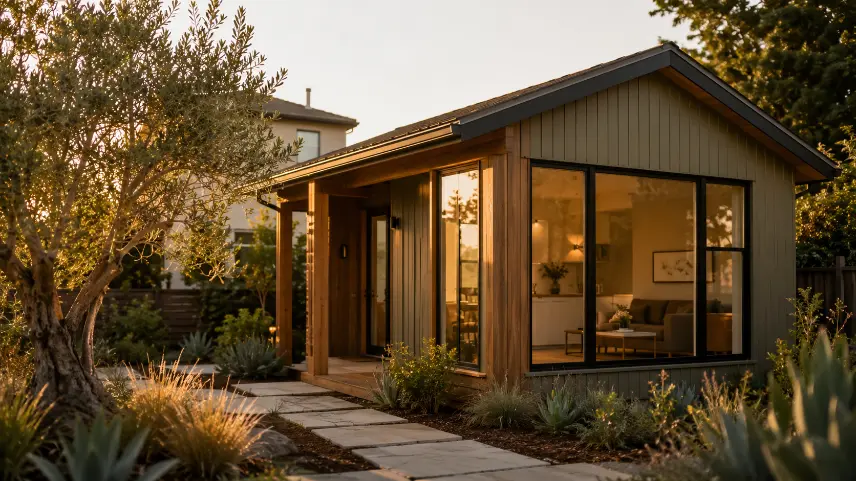
You're underwriting an ADU. Maybe you own a single-family rental in San Jose and you're trying to figure out whether a detached unit pencils. Maybe you're a Bay Area homeowner thinking about converting a garage and renting the unit out long-term. Either way, the question that decides whether you break ground is the same: what will it actually rent for?
This is the data piece. City-by-city rent ranges, what moves them, and how to think about an ADU as an income asset in 2026 — not as a generic home improvement. If you're earlier in the process and still deciding whether an ADU is the right structure for your situation, our guide on JADU vs. ADU options in the Bay Area is the right starting point.
ADU rents in the Bay Area scale primarily with city, secondarily with size, and tertiarily with finish quality and amenities. Ranges below reflect permitted, well-maintained ADUs with separate entrances, full kitchens, and full bathrooms — the kind of unit lenders and appraisers will treat as a real rental asset. Studios and rooms-with-kitchenettes rent below these ranges; unpermitted units rent meaningfully below and carry separate legal and insurance risk.
Palo Alto, Los Altos, Menlo Park, Atherton: Studios $2,400–$3,000. One-bedroom $3,000–$3,800. Two-bedroom $3,800–$4,500+. Proximity to Stanford and high-density employers pulls the top of the range.
Cupertino, Mountain View, Sunnyvale, Saratoga: Studios $2,300–$2,800. One-bedroom $2,900–$3,600. Two-bedroom $3,600–$4,200. Strong school districts and tech employer density support consistent occupancy.
San Jose (citywide average): Studios $1,900–$2,400. One-bedroom $2,500–$3,000. Two-bedroom $3,000–$3,800. North San Jose, Willow Glen, and Cambrian trend higher; East San Jose trends lower.
Santa Clara, Campbell, Milpitas: Studios $2,000–$2,500. One-bedroom $2,500–$3,100. Two-bedroom $3,100–$3,800.
Oakland: Studios $1,800–$2,400. One-bedroom $2,400–$2,900. Two-bedroom $2,900–$3,500. Significant submarket variation — Rockridge, Piedmont-adjacent, and Lake Merritt run higher; deeper East Oakland lower.
Berkeley: Studios $2,000–$2,500. One-bedroom $2,500–$3,200. Two-bedroom $3,200–$3,900. University demand keeps occupancy tight near campus.
Walnut Creek, Pleasant Hill, Lafayette, Orinda: Studios $1,900–$2,400. One-bedroom $2,500–$3,000. Two-bedroom $3,000–$3,600.
Fremont, Hayward, Union City: Studios $1,800–$2,300. One-bedroom $2,300–$2,800. Two-bedroom $2,800–$3,400.
San Francisco (citywide): Studios $2,300–$2,900. One-bedroom $2,900–$3,500. Two-bedroom $3,500–$4,300. Neighborhood variation is huge — Mission, Noe Valley, and Outer Sunset all behave differently. SF ADUs also carry distinct local regulatory considerations that other Bay Area cities do not.
San Mateo, Burlingame, Redwood City, Belmont: Studios $2,200–$2,700. One-bedroom $2,700–$3,400. Two-bedroom $3,400–$4,100.
These figures align with what independent Bay Area ADU operators are reporting. The Bay Area ADU Manager — a long-running Silicon Valley ADU management operation — publishes a regularly updated rent dataset sourced from RentCafe, Zumper, Apartments.com, RentHop, and managed-portfolio data, and the ranges above are consistent with that data as of early 2026.
Three variables move your ADU's rent more than anything else. Two are about the unit itself; one is about the city.
Location commands the premium. Same floor plan, same finishes, $1,000+/month difference between Palo Alto and East San Jose. There is no construction decision that overcomes geography. If your property is in a premium-rent city, the ADU pencils faster. If it's in a lower-rent submarket, the math still works — just over a longer horizon.
Size has diminishing returns. A 400 sqft studio rents for roughly $2,000–$2,500 across the Bay Area. A 600 sqft one-bedroom rents for $2,500–$3,300. A 1,000 sqft two-bedroom rents for $3,200–$4,200. The marginal rent per additional square foot drops as the unit gets larger. The sweet spot for most investor underwriting is 600–800 sqft — large enough to command one-bedroom-or-better rents, small enough to keep construction efficient.
Finish quality matters more than most owners think. A well-finished ADU — matching kitchen and bathroom finishes, separate entrance, in-unit laundry, decent natural light, parking access — rents 15–25% above an identical unit with builder-grade everything and a side-yard squeeze entry. In premium-rent cities, the rent premium more than pays back the finish upgrade in 3–5 years.
Once you have a defensible rent number for your city and unit size, the rest of the math is straightforward. Three numbers matter.
Construction cost. Bay Area ADU costs vary widely by type and city. Garage conversions typically run $120,000–$175,000. Attached ADUs run $180,000–$350,000. Detached ADUs run $250,000–$500,000+, with premium cities (Palo Alto, Saratoga, Los Altos) at the high end. Our existing ADU financing guide and the SB 1211 changes piece cover the funding and regulatory landscape.
Permit and soft costs. Add $15,000–$40,000+ on top of construction for permits, design, structural engineering, soils reports, and impact fees. Premium cities trend higher; San Jose has the most predictable permit cost structure of the major Bay Area cities and offers pre-approved ADU plans that can compress permitting timelines.
Property value lift. A permitted ADU typically adds $150,000–$300,000+ to a property's appraised value in the Bay Area. Our existing piece on whether ADUs increase property taxes and home value walks through the property-tax side specifically — important if you're underwriting after-tax cash flow.
A worked example. Take a 700 sqft detached one-bedroom ADU in Sunnyvale. Construction $325,000. Soft costs $30,000. All-in $355,000. Market rent $3,100–$3,400/month — call it $3,250 base case. Annual gross rent $39,000. After vacancy (5%), operating expenses (12–18% in California including property tax delta, insurance, repairs, management), net operating income lands in the $26,000–$28,000 range. Cash-on-cash return varies based on financing structure. Cap rate on the incremental investment lands in the 7–8% range — competitive with most Bay Area investment property at materially lower transaction friction than buying a separate rental.
That math gets better in Palo Alto, worse in deeper East Bay. It gets much better when the ADU lifts the underlying property's appraisal enough to refinance and pull capital back out — a strategy our BRRRR-in-the-Bay-Area piece (coming July 2026) will cover end to end.
Owner-occupancy is no longer required. Per California Department of Housing and Community Development guidance, AB 881 and subsequent legislation means local governments cannot impose owner-occupancy requirements on ADUs permitted after January 1, 2020. For investors, this matters: an ADU built on a non-owner-occupied rental property is fully rentable. The investment thesis is no longer dependent on the owner living in the main house.
Selling ADUs separately is now real in participating cities. AB 1033 allows cities to opt in to letting ADUs be sold as condominiums separate from the main house. San Jose was an early mover. Our existing piece on how to legally sell your ADU in California covers the mechanics. For investors, this turns the ADU from a long-term rental asset into a potentially flippable one — though the participating-city list is still limited and the resale market for condominium ADUs is still maturing.
Rent figures on this page are ranges and they will move. Bay Area asking rents shifted 3–8% across submarkets in 2025 according to multiple Bay Area rental reporting platforms, and the spread between premium and standard submarkets has continued to widen. ADU construction costs have also moved — material costs are up roughly 6% against 2024, per Cushman & Wakefield's 2026 tariff analysis, with further pressure expected as trade policy plays out.
Arch General Construction updates this guide each quarter to reflect current rent and cost data. For a current ADU feasibility study on your specific property — buildable footprint, city-specific permit costs, realistic rent range, and full cost-to-build — schedule a consultation. The ranges here will tell you whether an ADU could pencil. A site visit tells you whether it actually does on your lot.
Arch General Construction has completed ADU projects across the Bay Area — from new builds to garage conversions and full ADU conversions, including our Santa Clara ADU conversion, San Mateo ADU, and a Fremont new dwelling unit project. For investor clients we provide a feasibility-first process: a property walk, a buildable-footprint analysis tied to your city's specific ADU rules, a rent comp for your immediate submarket, and an itemized fixed-bid construction estimate. You get a number you can plug into your underwriting before you decide to break ground.
We are licensed, bonded, and insured in California. License status for any California contractor is verifiable through the Contractors State License Board.
How much does an ADU rent for in the Bay Area?ADU rents in the Bay Area range from roughly $1,800/month for a studio in lower-cost submarkets to $4,500+ for a two-bedroom in premium cities like Palo Alto, Cupertino, and Atherton. Most one-bedroom ADUs in the broader Bay Area rent in the $2,400–$3,500 range.
Which Bay Area city has the highest ADU rents?Palo Alto, Atherton, Los Altos, and Menlo Park consistently command the highest ADU rents in the Bay Area. Cupertino and Mountain View are close behind. Premium cities can rent ADUs 30–50% higher than lower-cost submarkets for the same floor plan.
Do I need to live in my house to rent out my ADU?No, not in California. AB 881 and subsequent legislation removed owner-occupancy requirements for ADUs permitted after January 1, 2020. See California HCD for the current statewide framework.
How long does it take to build an ADU in the Bay Area?Plan for 12–24 months from initial design to certificate of occupancy: 3–6 months for design and permitting, 6–12 months for construction. San Jose's pre-approved plans program can compress permitting significantly.
What's a realistic ROI on an ADU in the Bay Area?Most Bay Area ADUs deliver 7–10% cap rates on the incremental construction investment, with stronger returns in premium-rent cities. Including the property value lift at appraisal (typically $150K–$300K+), total return on capital is typically materially higher than buying a separate Bay Area rental property.
Can I sell my ADU separately from my main house?In participating cities, yes — AB 1033 enables this. San Jose was an early mover. The participating-city list is still expanding. See our piece on legally selling your ADU for current details.
The rent ranges above will tell you whether an ADU could work on your property. They won't tell you what's actually buildable on your lot, what your specific city's permit cost will be, or what a contractor will commit to in writing.
Contact Arch General Construction for an ADU feasibility consultation. We'll walk the property, pull your city's ADU rules, give you a realistic rent comp for your submarket, and put a written fixed-bid number against the build. The kind of analysis you can plug into your underwriting before you commit capital.

We're here to help you build your future. Whether you're ready to start your project or just have a few questions, our team is ready to assist. Contact us today to schedule a consultation or request more information.
Book a Consultation