
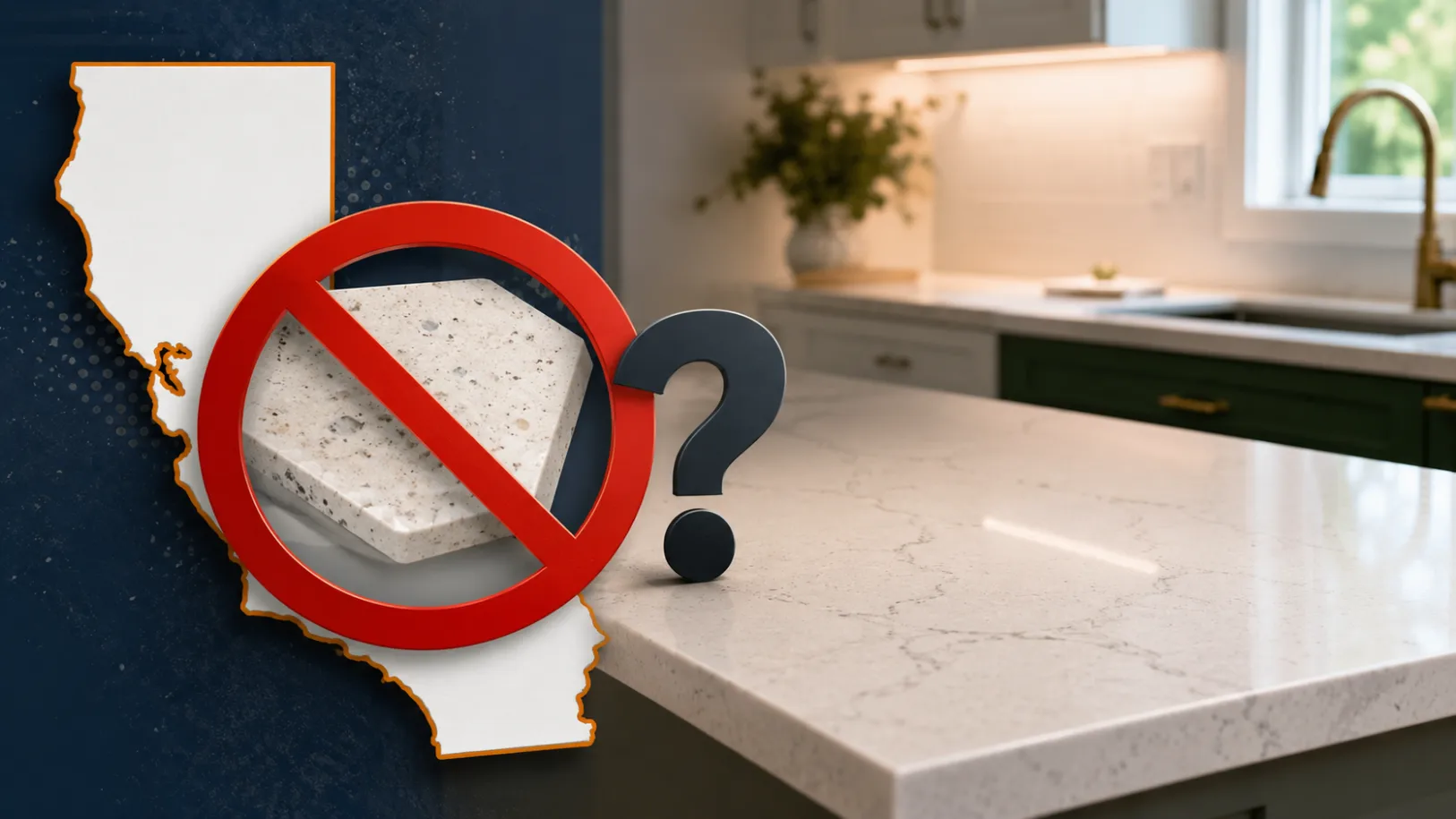
If you picked out a quartz countertop this year, you may have run into a headline suggesting California is about to outlaw it. That is unsettling news to hit halfway through planning a kitchen, especially when quartz has been the default choice in Bay Area remodels for the better part of a decade.
Here is the straight answer, followed by what it actually means for a project you are planning right now.
As of August 2026, engineered stone countertops — the category that includes nearly all quartz — remain fully legal to buy, fabricate, and install in California. Nothing you have already ordered is affected. Nothing already installed in your home is affected.
What changed is that regulators started the process that could lead to a ban. According to the California Department of Industrial Relations, the state's Occupational Safety and Health Standards Board voted unanimously on May 21, 2026 to direct Cal/OSHA to begin emergency rulemaking on engineered stone containing more than 1% crystalline silica. The department says the action followed a petition from the Western Occupational and Environmental Medicine Association, and that Cal/OSHA staff evaluations concluded the silicosis crisis "continues to worsen." If the rule is written and adopted as described, it would prohibit the fabrication and installation of those materials in California.
Two things are worth understanding about that sentence. First, this is a workplace safety rule, not a consumer product ban. It targets the people who cut and install slabs, not the people who own them. Second, emergency rulemaking is fast by California standards but not instant — a draft standard could appear late in 2026, and any final rule would still move through advisory committees. Timing is genuinely uncertain.
This is not a design trend story. It is a documented occupational disease outbreak, and the numbers are the reason regulators stopped treating enforcement alone as sufficient.
Crystalline silica is a mineral found in stone. When a slab is cut, ground, or polished, it releases microscopic dust. Inhaled over time, that dust causes silicosis — permanent scarring of the lungs that is progressive and has no cure. The disease keeps advancing even after exposure ends.
Engineered quartz is unusually hazardous to fabricate because it is unusually silica-rich. A NIOSH science bulletin from the CDC puts the respirable crystalline silica content of engineered stone at typically over 90%, and reports that California Department of Public Health research found 51% of inspected stone fabrication shops had at least one employee exposed above the permissible limit.
The case count tells the rest. In a surveillance report published in NEJM Evidence, California Department of Public Health researchers and academic partners identified 592 silicosis cases among engineered stone countertop workers in the state between January 2019 and June 2026. Of those workers, 65 required lung transplants and 31 died. The index case was a worker who started the job at 32 and died of respiratory failure at 38.
This is not only a Southern California problem, though Los Angeles and Orange counties carry the heaviest burden. A CDPH health advisory issued in November 2025 — the same advisory announcing that silicosis had become a reportable disease in California — listed confirmed cases by county, including 19 in Contra Costa and 15 in Alameda. The department also noted a median age at diagnosis of 46, and that the affected workforce is primarily immigrant men.
The state has been escalating for years. As the Department of Industrial Relations documents, Cal/OSHA adopted an emergency silica standard for stone fabrication in December 2023 under Title 8, Section 5204, and the Standards Board made a permanent standard effective in February 2025. In October 2025, Governor Newsom signed Senate Bill 20, the Silicosis Training, Outreach, and Prevention Act, which added training, reporting, and enforcement requirements. The bill's own legislative findings note that Australia became the first country to ban engineered stone outright, on July 1, 2024. The May 2026 vote came after all of that, because the case count kept climbing anyway.
Nothing, in practical terms. A cured, installed slab in your kitchen is inert. It does not shed silica dust. There is no exposure risk to your household from a finished countertop, and no proposed rule would require anyone to remove one.
The one moment that matters is demolition. If an existing stone countertop is cut apart during a remodel rather than removed intact, that is a dust-generating operation covered by California's silica rules. That is a job-site handling question rather than something a homeowner manages, but it is a fair thing to raise when you are planning a tear-out. Sequencing surprises are one of the more common ways a kitchen project loses time, which we cover in what actually causes construction projects to go sideways.
Your exposure to this issue depends almost entirely on when your slab gets fabricated.
Installing in the next few months: you are very likely fine. Quartz is legal, available, and fabricators are working. Proceed.
Installing in 2027 or later: this deserves a real conversation before you commit. If an emergency standard lands mid-project, the risk is not that your countertop becomes illegal. It is that your fabricator cannot legally cut it, which means re-selection, re-templating, and a schedule slip in the final phase of a remodel, when delays cost the most.
Ordering material far in advance: be cautious about pre-buying slabs for a project a year out. A slab you own is worth nothing if no shop in California can fabricate it.
There is a pricing dimension too. Quartz has historically installed in the range of roughly $70 to $120 per square foot in this market, with sintered and premium surfaces running higher. Regulatory uncertainty pushes in two directions at once — some inventory gets discounted to move, while fabricators with capacity for alternative materials get busier and price accordingly. Treat any countertop quote from six months ago as stale. This is the same pattern we have seen on cabinetry, where trade policy moved pricing faster than anyone's budget spreadsheet could keep up; our breakdown of how 2026 tariffs are driving up Bay Area construction costs covers that side.
Countertops usually run somewhere around 10% to 15% of a kitchen budget, so this moves a real number without being the line that decides a project. If you are still assembling the overall budget, our guide to how Bay Area homeowners pay for a major remodel covers the financing side.
One more thing worth knowing: the proposed rule reaches bathroom vanity tops as well as kitchen counters, since they are cut from the same slabs. If a bathroom is in scope this year, factor it into the same material decision rather than treating it separately — our bathroom remodel cost guide walks through where the rest of that budget goes.
The good news is that the market saw this coming. Australia's ban pushed manufacturers to develop substitutes, and several are now shipping in North America.
Low-silica and silica-free engineered stone. Several major manufacturers now produce engineered surfaces under 1% crystalline silica, replacing silica aggregate with recycled glass, feldspars, or minerals processed so the silica is no longer in crystalline form. These look and behave the most like the quartz you were probably choosing. Skip this if you need a specific color or pattern that has not been reformulated yet — the low-silica ranges are still narrower than full quartz catalogs.
Sintered stone and large-format porcelain. Made by fusing minerals under heat and pressure without resin binders. Typically very low or zero crystalline silica, non-porous, heat resistant, and UV stable, which makes them the realistic choice for an outdoor kitchen. Skip this if your budget is tight or your fabricator is inexperienced with them — these materials are more brittle to handle, harder to cut, and generally cost more installed.
Natural stone. Granite and quartzite are beautiful and durable, but be clear-eyed: they contain crystalline silica too, just far less than engineered quartz, and the proposed rule as described targets engineered stone specifically. Marble and soapstone are much lower in silica but softer and more prone to staining and etching. Skip granite if you were choosing quartz mainly to avoid periodic sealing.
Solid surface, butcher block, stainless, and concrete. All silica-free. Solid surface is repairable and seamless but less heat tolerant. Butcher block is warm and inexpensive but demands maintenance. Stainless is durable and scratches visibly. Skip these if resale is a priority in a high-end Bay Area neighborhood, where buyers still expect a stone or stone-look surface.
Three questions cover most of the risk:
If a countertop swap is the whole job, this is a straightforward material decision. If it is one piece of a gut kitchen or a larger renovation, it is one variable among many, and usually not the one that should drive your timeline.
Arch General Construction works on kitchens and full-home renovations across the South Bay and Peninsula, and you can see the range of completed work on our projects page. Regulatory shifts like this one are far easier to absorb when material selection happens early rather than in the last few weeks. It is also worth knowing that a gut remodel can carry property tax consequences a cosmetic update does not, which we cover in does remodeling raise your property taxes in the Bay Area.
Whatever you choose, settle the material question before demolition starts rather than after.
If you are planning a kitchen and are not sure whether to hold your quartz selection or move to a low-silica alternative, that is a fifteen-minute conversation, not a research project. Contact Arch General Construction and we can talk through where your project sits on the timeline and what your realistic options are.
A note on this article: This is general information about a pending California regulatory action, not legal or medical advice. Regulatory status can change quickly — confirm the current rule with Cal/OSHA before making a decision that depends on it. If you have health concerns related to silica exposure, speak with a physician.

We're here to help you build your future. Whether you're ready to start your project or just have a few questions, our team is ready to assist. Contact us today to schedule a consultation or request more information.
Book a Consultation