
Last updated: April 2026
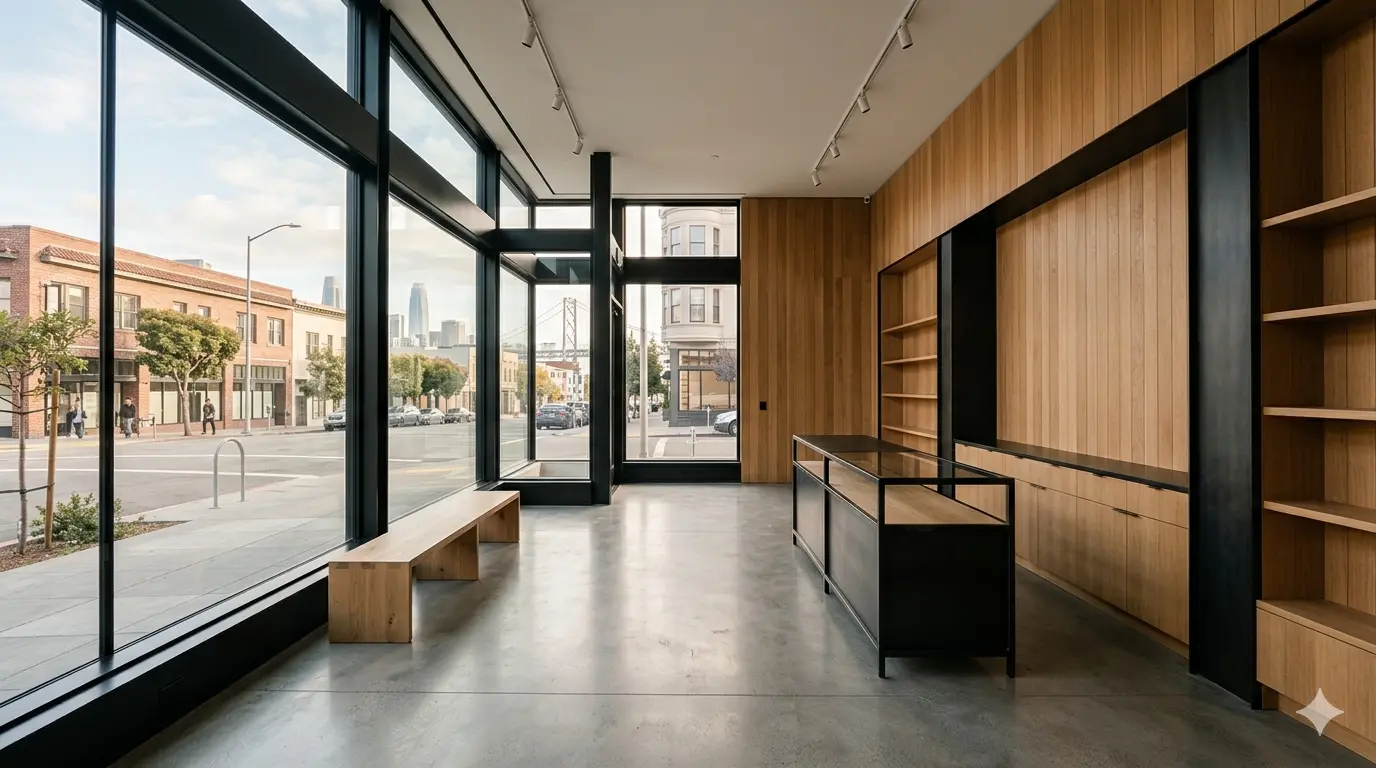
You just signed (or are about to sign) a commercial lease in the Bay Area, and now you're staring at an empty shell and a tenant improvement allowance that may or may not cover what you actually need. Maybe you're a restaurant operator opening in a former retail space in San Jose. Maybe you're an office tenant expanding into a Class A floor in SOMA. Maybe you're a dentist taking over a bank branch in Walnut Creek. The playbook is the same regardless of vertical: understand what TI actually costs in 2026, know what your TI allowance is really worth, and partner with a contractor who's fluent in the city permit process before you break ground.
This guide walks through all of it. If you're earlier in the process and still comparing contractors, our post on how to compare contractor proposals like a professional is a good pairing with this one.
A tenant improvement (TI), sometimes called a build-out or fit-out, is the work required to convert a leased commercial space from its current condition into one that fits your business. That can mean anything from painting and flooring in a turnkey office suite to full structural work, new plumbing rough-in, new electrical service, dedicated HVAC, specialty equipment, and code-compliance upgrades for restaurants, medical offices, and other specialized uses.
Tenant improvements are not the same as deferred maintenance. They are not the landlord's building-system repairs. They are the scope of work your business needs to operate in that specific space — and the division of responsibility between tenant and landlord for that scope is negotiated in the lease and funded, at least partially, by a tenant improvement allowance.
Every commercial tenant improvement project in San Francisco requires a building permit, per the San Francisco Department of Building Inspection's commercial construction requirements. Similar rules apply in every other Bay Area city. There is no legal way to build out a commercial space without one.
Bay Area TI costs run high by national standards, and they've moved upward through 2025 and into 2026 because of the same tariff and labor pressures affecting every construction category. According to the JLL 2025 U.S. and Canada Office Fit-Out Cost Guide, the national Q1 2025 average for a moderate-quality medium-style office fit-out was $280 per square foot. JLL's 2026 Global Fit-Out Cost Guide identifies San Francisco as one of the top five most expensive cities in the world for office fit-outs, with layout typology alone capable of swinging project costs 10–13% and specification choices driving even larger variance.
Against that baseline, here is what Bay Area TI projects typically cost in 2026 by property type. All figures are ranges per square foot of improved space, inclusive of construction but exclusive of furniture, IT, signage, and movable equipment.
Three dynamics move a TI project inside its category's range, and a fourth dynamic moves everything in 2026.
**Building systems and M&E. ** Mechanical and electrical work is where TI budgets win or lose. JLL's research consistently finds M&E services accounting for roughly 29% of office fit-out costs globally, with significant regional variation. In the Bay Area, pulling new power, upgrading HVAC for higher occupancy density, or routing new plumbing for a restaurant or medical use can account for 35–45% of total project spend. The condition of the existing building's systems is the single biggest variable you should investigate before signing a lease.
Typology and layout. Private-office-heavy layouts cost more than open-plan. High-collaboration layouts with huddle rooms and conference centers run higher than standard bullpen floors. More walls means more doors, glazing, electrical runs, and HVAC zones.
Finish specification. This is the lever tenants have the most control over. Commodity carpet vs. wool plank. Standard millwork vs. custom casework. Building-standard lighting vs. specified decorative fixtures. The same layout can swing 30% on finishes alone.
2026 tariff and labor pressure. According to Cushman & Wakefield's April 2026 tariff analysis, current tariff rates have raised construction materials costs approximately 6% against a 2024 baseline, with further pressure expected. The Bay Area Council has documented the compounding effect on steel and aluminum specifically, which hits office and industrial TI scopes hardest. Labor is the other side of the squeeze — JLL's 2026 outlook flags a persistent shortage of skilled mechanical and electrical trades in the Bay Area as a structural cost driver. Any contractor quoting you 2024 numbers in 2026 is going to come back for a change order.
A tenant improvement allowance (TIA) is money the landlord commits in your lease to help fund your build-out. It's calculated per square foot of leased space. A 5,000-square-foot office at $50/sqft TIA delivers $250,000 toward construction.
The Bay Area market for TIAs has been competitive through 2024 and 2025 as landlords work to attract and retain tenants in a softer office market. CBRE research has documented Silicon Valley TIA packages starting as high as $150/sqft and landlords in some submarkets offering $100–$200/sqft depending on space condition, lease term, and tenant credit. That doesn't mean every tenant gets those numbers — but it does mean the negotiation is live.
Two things every tenant should understand about TIA before signing:
It often excludes what you actually need. TIA typically covers permanent improvements that stay with the space: walls, doors, flooring, ceilings, HVAC, plumbing, electrical distribution, built-ins. It typically excludes furniture, IT and AV equipment, telecom cabling in some leases, signage, specialty equipment, relocation costs, and moving expenses. Read the definition in your lease carefully and ask your broker or attorney to flag exclusions.
Reimbursement structure matters. Some TIAs are paid as reimbursements after construction completes and lien waivers are delivered. Others fund progress payments during construction. The difference is real cash-flow work for your business. Negotiate for progress payments if you can — a full-reimbursement TIA means your company is funding the full build-out upfront and waiting months for the landlord's check.
A practical rule of thumb for 2026 Bay Area negotiations: get a contractor-prepared estimate for your specific scope before the TIA figure is finalized in the lease. Landlords often start with TIA numbers anchored to building-standard work, which may not match what your business actually needs. Bringing real numbers to the table moves the number. Our guide on how to stop your Bay Area project from going over budget covers the same contractor-early principle on the residential side.
Every tenant improvement in the Bay Area requires a building permit, and the permit process varies substantially by city. Plan your schedule accordingly.
The San Francisco Department of Building Inspection oversees all commercial TI permits. San Francisco distinguishes between over-the-counter (OTC) permits for simpler projects — including many small commercial TIs — and in-house review for more complex work. The SF.gov OTC commercial project guide details which scopes qualify.
Realistic timelines:
SF also requires disability access (ADA) review as part of the standard DBI plan review process. This was consolidated into DBI from the former Office on Disability and Accessibility in 2023.
San Jose runs through the City of San Jose Development Services Permit Center. Commercial TIs typically go through standard plan review; the city's Residential Express Service does not apply to commercial work. Plan-check timelines for standard commercial TIs have run longer than historical norms through 2025 due to application volume. Plan for several weeks to several months depending on scope and cycle count.
Each East Bay city runs its own building department. Oakland commercial TI permits typically move on a similar cadence to other East Bay jurisdictions — usually 6–12 weeks for plan review on standard scopes, longer for complex or change-of-use projects.
Palo Alto, Mountain View, Sunnyvale, Santa Clara, San Mateo, and Burlingame each run independent permit programs. Timelines are generally more predictable than San Francisco but vary meaningfully between cities. Never assume Sunnyvale's timeline matches Palo Alto's.
Whatever the city's stated timeline, add a review cycle. Most commercial TI projects go through 2–4 correction cycles — plan reviewer comments that require revisions and resubmittal. Each cycle adds weeks. A single-cycle clean approval is the exception, not the baseline.
Based on our experience across commercial TI work in the region — from the Sweet Moments boba shop in San Mateo, to a new acupuncture store in San Jose, to commercial flex work in Milpitas and our commercial factory project — every successful Bay Area TI shares four characteristics.
Every cost figure on this page is a range, and that's deliberate. Bay Area commercial construction inputs have moved 6–12% year-over-year through 2025 and into 2026, with M&E components, steel, and imported finish materials leading the volatility. Per JLL's 2026 Global Fit-Out Cost Guide, global fit-out costs have risen 2–6% across regions in the past year, with North America elevated by trade tariffs and skilled-labor shortages. San Francisco specifically has been called out as one of the most expensive fit-out markets in the world.
Arch General Construction updates this guide each quarter. For a current, fixed-bid estimate on your specific commercial project — scope, building condition, city, finish level all accounted for — schedule a consultation. The ranges here will orient your TIA negotiation and your capital plan. A site walk will give you a number you can actually underwrite.
Arch General Construction runs commercial tenant improvements across the Bay Area — office, retail, restaurant, light industrial, medical. You can see representative commercial projects in our projects gallery, including the San Mateo boba shop, San Jose acupuncture build-out, and Milpitas commercial flex work mentioned above.
We are licensed, bonded, and insured in California. You can verify any California contractor's license through the Contractors State License Board. Our commercial TI process:
How much does a commercial tenant improvement cost in the Bay Area?Bay Area TI costs typically run $35–$80/sqft for light cosmetic office, $90–$180/sqft for standard office build-outs, $200–$350+/sqft for Class A office, $250–$400/sqft for fast-casual restaurants, $350–$600/sqft for full-service restaurants, and $200–$500/sqft for medical and dental work. Actual cost depends on scope, building condition, finish level, and city.
What is a typical tenant improvement allowance in the Bay Area?TIAs vary widely by submarket, lease term, tenant credit, and space condition. CBRE has reported Silicon Valley TIA packages starting as high as $150/sqft and broader Bay Area ranges of $100–$200/sqft in competitive markets. Turnkey and shorter-term leases typically come with lower allowances.
Do I need a building permit for a commercial tenant improvement in San Francisco?Yes. San Francisco DBI requires a building permit for every commercial tenant improvement. Some simpler scopes qualify for over-the-counter review; more complex projects go through in-house review with typical timelines of several months.
How long does a Bay Area commercial TI take from signed lease to move-in?A realistic range for most commercial TIs in the Bay Area is 4–9 months from lease signing: 2–6 weeks for design, 6–24 weeks for permits depending on city and scope, and 8–16+ weeks for construction. High-complexity projects (restaurants, medical, change-of-use) trend longer.
What does a TI allowance not cover?Typically: furniture, IT and AV equipment, telecom (sometimes), signage, specialty business equipment, relocation, and moving expenses. Always verify the exclusions list in your specific lease.
Can I negotiate my TI allowance after the lease is signed?Usually not. TIA is negotiated during lease drafting. The leverage is highest before you sign. Getting a real contractor estimate for your scope before the TIA number is locked in is the single most effective way to push the number up.
The ranges and timelines in this guide will orient your planning. They won't tell you what your specific space, your specific scope, and your specific city will actually cost.
Contact Arch General Construction for a commercial TI consultation. We'll walk the space with you, flag feasibility issues your broker probably won't, and give you a written estimate you can take into your lease negotiation.

We're here to help you build your future. Whether you're ready to start your project or just have a few questions, our team is ready to assist. Contact us today to schedule a consultation or request more information.
Book a Consultation